


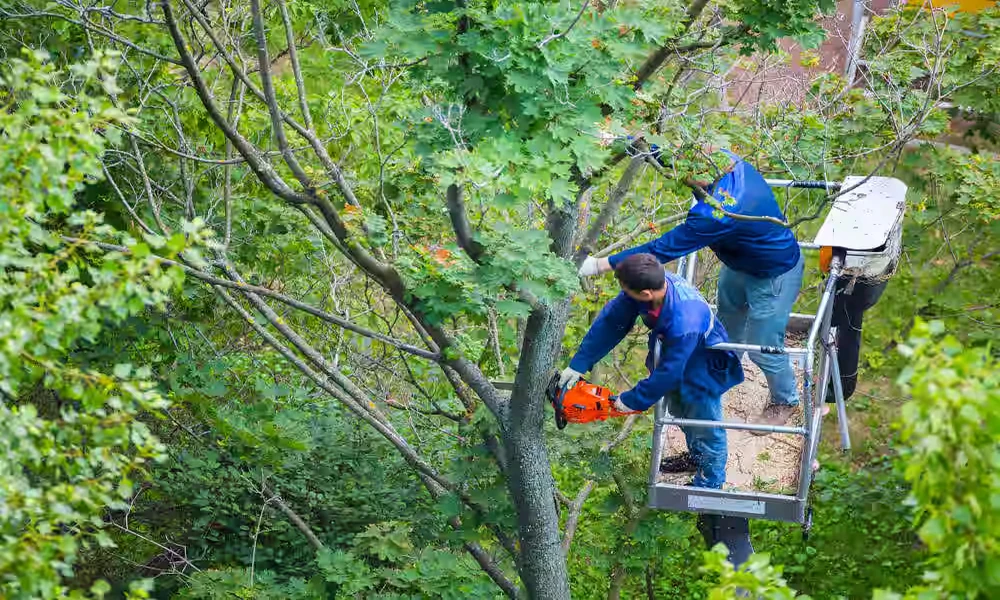
Tree cutting requires expertise that is easy to underestimate until something goes wrong. A tree in a garden looks like a straightforward removal until the first major cut reveals a hollow trunk, a root system that has undermined nearby paving, or a lean toward a fence that changes every calculation made at ground level. In Singapore’s urban environment, where trees grow in close proximity to buildings, neighbouring properties, and power infrastructure, professional tree cutting expertise is not optional – it is the factor that determines whether a job finishes cleanly or creates a crisis.
What Tree Cutting Expertise Actually Involves
A qualified arborist approaching a tree removal does not see a tree and a chainsaw. They see a structure with a centre of gravity, a lean in a particular direction, a root system with a specific spread, and a weight distribution that determines every cut in the sequence to come. They assess the canopy for dead wood that might shift unpredictably. They look for structural defects cracks, included bark, co-dominant stems at risk of splitting, that affect how the tree will behave when cut.
This assessment, completed before a single cut is made, determines the method. A tree in open space with a clear drop zone can often be directionally felled in one or a few passes. A tree in a confined residential garden, standing close to a building, is taken down in sections from the top, with each section rigged and lowered before being cut free. A tree overhanging a boundary or a road requires coordination with neighbours, and sometimes with authorities, before work can proceed.
The method shapes the equipment selection, chainsaw sizes, rigging gear, stump grinder specification, and the team composition. None of this is generic, and professionals who skip the assessment step produce unpredictable outcomes.
The Regulatory Dimension
Tree cutting in Singapore operates within the Parks and Trees Act framework, which requires a NParks permit for any tree with a girth above 100 centimetres at one metre above ground level on private land. The penalty for felling a protected tree without a permit reaches $50,000. A professional tree removal service will check the permit requirement for each tree before work begins and manage the application process as part of the project.
Homeowners can also independently verify requirements through NParks guidance on tree felling permits before engaging any contractor.
This regulatory knowledge is part of the expertise a professional team brings. A contractor who begins work without checking permit status – or who advises the property owner that the permit requirement does not apply when it does, creates legal exposure that the property owner carries, not the contractor.
Site Clearance as a Complete Service
Tree removal is rarely a single-tree job in the context of site clearance. Development projects, estate renovations, and overgrown property remediation often involve clearing multiple specimens from a site within a defined programme. In these contexts, the requirements extend beyond the individual trees to cover the sequencing of the work, the disposal of material, and the condition of the site after completion.
An experienced team handles the full scope, removal, stump grinding, chipping or disposal of green waste, and final site clean-up. Clients should not have to coordinate multiple contractors for these connected tasks, and a site clearance specialist who handles the full process from tree-standing to site-ready reduces both cost and coordination effort.
As Lee Kuan Yew once noted about the standards Singapore holds itself to, “We do not accept mediocrity, in public works or in private ones.” Tree removal is the kind of private work where the difference between expert and amateur has consequences for property, safety, and neighbourly relations that last well beyond the day the contractor leaves.
Selecting a Team Worth Trusting
When evaluating a tree cutting contractor, these criteria separate the professionals from the rest.
Full public liability insurance that covers tree work specifically, not just general site liability. Arboricultural qualifications on the core team, ISA Certified Arborist credentials or equivalent. Experience with the specific type of removal the project requires, whether that is a single residential garden specimen, a confined commercial courtyard, or a multi-tree site clearance. A clear work plan, produced after a site inspection, that addresses the specific constraints of the project.
For Singapore property owners who need tree removal done safely, within the regulatory framework, and with a site left in good order when the work is done, engaging qualified tree cutting experts is the only approach worth taking.

