


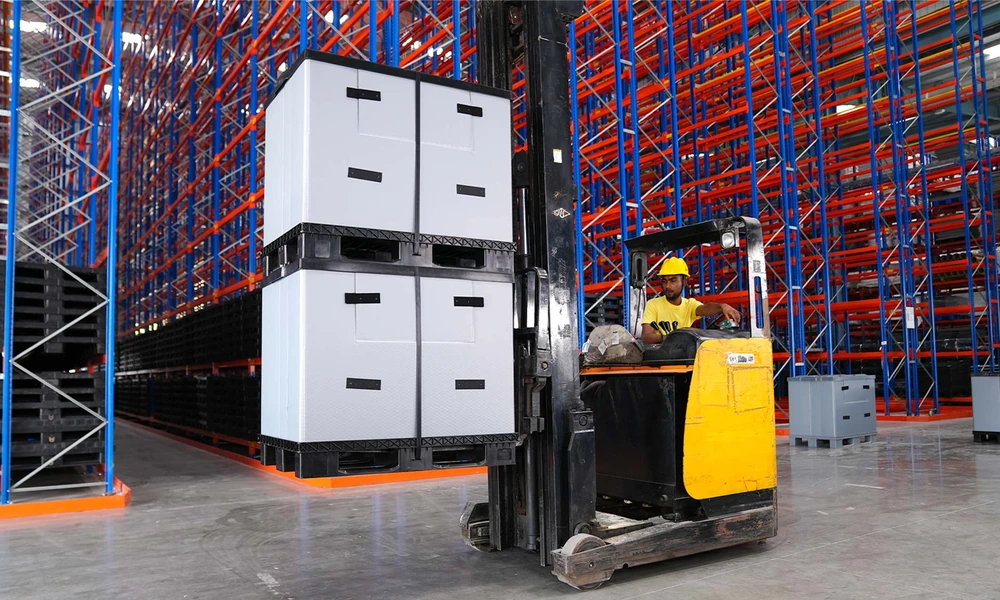
Bulk producers eventually reach a point where filling containers one at a time, however efficient the single-station equipment, can’t match the pace of orders coming in, and the answer usually involves scaling up to systems that fill multiple containers together or move filled product directly into palletized formation. The benefits of this shift extend well beyond raw speed, touching labor allocation, product consistency, and how efficiently a warehouse can turn around a large order.
Bulk Production Pressures on Filling Lines
A business shipping bulk quantities of a liquid or semi-liquid product faces a different set of production pressures than one filling small retail batches, since a single large order might require hundreds of containers filled, capped, and palletized within a tight delivery window. Single-station filling equipment, even when it runs quickly, creates a serial bottleneck where every container passes through one fill point before moving on, and that bottleneck becomes more pronounced as order sizes grow. Pallet-scale filling systems address this directly by filling multiple containers in parallel or by tightly integrating the fill and palletizing steps, reducing the total time needed to process a large order from raw product to shipped pallet.
Labor Reallocation When Filling Is Automated
Manual filling and palletizing at bulk scale typically requires several workers stationed along the line: one or more filling containers, others capping and labeling, and still others stacking finished containers onto pallets for shipping. Automating this sequence doesn’t necessarily eliminate every one of these roles, but it does shift labor away from repetitive physical tasks toward line monitoring, quality checks, and handling exceptions like a jammed container or an empty product hopper. Businesses that make this shift often find their existing staff can support higher output without proportionally increasing headcount, since the physical bottleneck that previously limited throughput no longer depends on how many people are available to work the line.
Consistency Across High-Volume Runs
Fill weight, cap torque, and container placement all carry more variability when handled manually across a large production run simply because human attention and physical stamina fluctuate over the course of a shift. Automated pallet filling systems maintain the same fill parameters from the first container in a run to the last, which matters considerably for businesses whose customers expect consistent product quantities across every shipment, particularly in export markets where receiving customers may audit incoming shipments against declared specifications. This consistency also simplifies quality control internally, since a stable process generates fewer out-of-tolerance containers that need to be caught, set aside, and investigated.
Warehouse Turnaround and Order Fulfillment
Bulk buyers often place orders that need to leave the warehouse within days rather than weeks, and a filling operation that can’t keep pace with this rhythm puts pressure on every stage that follows, from staging to outbound logistics. A pallet filling system shortens the gap between an order being confirmed and the corresponding pallets being ready for pickup, since containers move through filling, capping, and staging as a continuous batch rather than accumulating one at a time from a single-station line. This matters most during periods of concentrated demand, when several large orders land close together and a warehouse team needs predictable turnaround times to plan truck bookings and loading bay schedules without last-minute scrambling to catch up on a backlog of partially filled orders.
Reducing Product Giveaway Through Accurate Dosing
Product giveaway, the industry term for product dispensed beyond the declared fill volume, represents a real and often underestimated cost on bulk production lines, since even a small percentage of overfill compounds across a large production run into a significant volume of lost product. Systems built around pallet-scale filling and palletizing equipment generally hold tighter fill tolerances than manual dispensing precisely because the dosing mechanism doesn’t depend on an operator’s judgment call about when to stop a fill cycle. Over a full year of bulk production, the cumulative savings from reduced giveaway frequently offset a meaningful portion of the equipment’s cost, which is a calculation worth running before dismissing automation as too capital-intensive for a given operation.
From Filling to Palletizing in One Workflow
One of the more practical benefits of a well-integrated pallet filling system is how it collapses several previously separate steps, filling, capping, labeling, and palletizing, into a single continuous workflow rather than a series of disconnected stations each requiring its own handoff. Fewer handoffs mean fewer opportunities for a container to be mishandled, mislabeled, or placed incorrectly on a pallet, and it also shortens the total time between a container leaving the filling station and being ready for shipment. For businesses running against tight order fulfillment windows, this compressed workflow often matters as much as the raw throughput increase, since it directly affects how quickly a large order can move from production to the loading dock.
The case for pallet filling systems in bulk production rests on a combination of factors rather than any single advantage, spanning reduced product giveaway, more consistent output, better labor allocation, and a shorter path from filling to a shipment-ready pallet. Businesses weighing this investment should look at their actual order patterns and current bottlenecks rather than assuming automation delivers value uniformly, since the specific mix of benefits that matters most, whether that’s labor savings or giveaway reduction, differs depending on what’s currently constraining a given production line. A useful next step is mapping the current line from raw product to loaded pallet and marking where delays or inconsistencies actually occur, since that map usually points directly to which of these benefits a given plant stands to gain the most from.

