


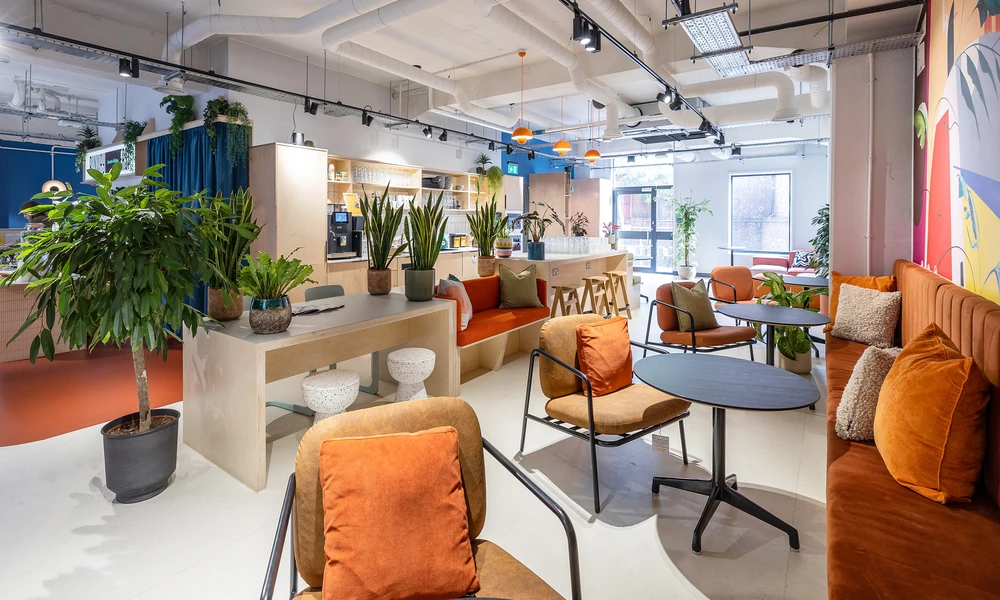
The hybrid office has changed how often people come in, but it has not changed why they come in. Among remote-capable employees in the United States, about half work a hybrid schedule (Gallup). For many of them, office days are reserved for meetings, problem solving, and collaborative work that is harder to do on a screen.
Why do office days focus on collaboration?
Office days focus on collaboration because individual work is easy to do from home. Teams choose in-person days for brainstorming, planning, and decisions that benefit from everyone in the same room. That shift raises the value of rooms designed for group thinking and lowers the value of rows of assigned desks.
How has office attendance changed?
Office attendance remains well below pre-pandemic levels in many markets. Badge data from major United States cities has shown average occupancy near half of pre-2020 levels (Kastle Systems), so the space that remains in use needs to work harder.
How are whiteboard designs adapting to modern offices?
Whiteboard designs are adapting with cleaner, architectural profiles. Frameless porcelain boards use hidden hardware for a clean, easy-to-sanitize installation, and their frameless edges reduce dust buildup and simplify cleaning (ASI Visual Display Products). The look fits contemporary interiors where visible trim and trays can feel dated.
Why does porcelain suit shared workspaces?
Porcelain suits shared workspaces because it resists ghosting and staining across many users and markers. A surface that erases cleanly keeps rooms ready for the next team without extra cleaning.
Why do physical whiteboards still matter?
Physical whiteboards still matter because they are fast, visible, and require no setup. Anyone can pick up a marker and sketch an idea, and the work stays on the wall for the rest of the meeting. Digital tools complement them, but they rarely replace the speed of writing on a large surface in the moment.
Which spaces benefit most from writable walls?
Several office spaces benefit from large writing surfaces:
- Project rooms where teams return to work over several days
- Conference rooms used for planning and decisions
- Open collaboration zones near team neighborhoods
- Training rooms used for onboarding and workshops
How does remote participation affect board placement?
Remote participation affects board placement because hybrid meetings include people on video. Roughly one in five workers in the United States teleworked at least some hours in recent federal labor surveys (Bureau of Labor Statistics). Boards placed within camera view, with even lighting and low-glare finishes, help remote participants follow the work.
Which details improve hybrid meetings?
Low-gloss surfaces, high-contrast markers, and camera-friendly placement improve hybrid meetings. Some teams also photograph boards at the end of each session and share the image so remote colleagues keep the record.
How do frameless boards fit into broader interior design?
Frameless boards fit broader interior design by reading as part of the wall rather than as equipment. Designers can align boards with wall panels, millwork, or glass partitions and run them edge to edge across a room. The result supports collaboration while keeping the visual calm that modern office interiors aim for.
How large should collaboration boards be?
Collaboration boards should be large enough for several people to write at the same time. Boards that span most of a wall let teams map processes, compare options, and keep earlier work visible while they continue to build on it.
How should boards be cleaned in shared offices?
Boards in shared offices should be cleaned at the end of each day so the next team starts fresh. Facility teams can stock rooms with fresh markers and board cleaner, remove dried-out pens, and wipe surfaces during evening rounds. Small routines like these keep collaboration rooms ready and encourage teams to use the boards rather than avoid them.
What should workplace designers prioritize?
Workplace designers should give every collaboration room generous, durable writing space. Frameless porcelain boards, placed for both in-person and remote participants, help hybrid offices deliver the collaboration that brings people back to the building.

